UniFAST Scholarship 2026: Complete Guide to Financial Assistance for Filipino Students

The rising cost of college and technical-vocational education can make it difficult for many Filipino students to manage their studies. In addition to tuition and school fees, students may need to cover transportation, books, learning materials, accommodation, and other education-related expenses. To help eligible learners manage these costs, the Philippine government provides several forms of financial assistance through the Unified Student Financial Assistance System for Tertiary Education (UniFAST). Established under Republic Act No. 10687, UniFAST provides a unified framework for government-funded scholarships, grants-in-aid, student loans, and other forms of tertiary education assistance.
Through Republic Act No. 10931, UniFAST also supports the implementation of major government education assistance programmes, including Free Higher Education, the Tertiary Education Subsidy (TES), the Student Loan Program, and Free Technical-Vocational Education and Training (FTVET). However, it is important to understand that UniFAST scholarship does not refer to one single scholarship with a universal application form or fixed benefit. Instead, UniFAST covers multiple programmes, each with its own eligibility requirements, financial benefits, prioritisation rules, documentation, and application procedures. Students should identify the programme that applies to their situation and check the latest official requirements before applying.
What Is UniFAST Scholarship?
The Unified Student Financial Assistance System for Tertiary Education (UniFAST) is a Philippine government framework that coordinates and implements different financial assistance programmes for students pursuing tertiary education. It operates within the Commission on Higher Education (CHED) framework and works closely with higher education institutions and relevant government agencies to help deliver scholarships, subsidies, grants, loans, and other forms of student assistance.
It is important to understand that UniFAST is not a single scholarship programme with one application process or fixed benefit. Instead, it brings together several government-funded education assistance programmes designed to help eligible Filipino students access and complete higher education or technical-vocational education and training. Each programme has its own eligibility requirements, benefits, application procedures, and prioritisation rules, so students should check the specific programme that applies to their situation. Visit Homepage
The official UniFAST framework under Republic Act No. 10931 currently includes four major programmes:
- Free Higher Education (FHE)
- Tertiary Education Subsidy (TES)
- Student Loan Program
- Free Technical-Vocational Education and Training (FTVET)
Each programme serves a different purpose. Some provide tuition and school-fee exemptions, while others provide financial subsidies, loans, training assistance, or additional education-related support.
UniFAST Scholarship Programmes at a Glance
| Programme | Main Students Covered | Main Assistance |
|---|---|---|
| Free Higher Education (FHE) | Eligible Filipino students enrolled in qualified SUCs and CHED-recognised LUCs | Exemption from tuition and covered school fees |
| Tertiary Education Subsidy (TES) | Priority students enrolled in eligible SUCs, LUCs, and private HEIs | Financial assistance for qualified education-related expenses |
| Free TVET / FTVET | Eligible learners enrolled in qualified TESDA-registered TVET programmes | Assistance covering eligible training and assessment costs, plus specified support |
| Student Loan Program | Eligible tertiary students who meet the programme requirements | Student loan assistance for qualified education expenses |
Because programme guidelines, funding availability, and implementation procedures may change, students should always verify the latest information through official UniFAST sources before applying.
UniFAST Scholarship and Financial Assistance Programs
Many students search for a UniFAST scholarship when looking for government financial support for education. However, UniFAST is not a single scholarship programme. It covers several government-funded programmes that provide different types of assistance to eligible Filipino students. Understanding these programmes can help students identify which financial assistance may apply to their course, school, or training programme.
1. Free Higher Education
Free Higher Education (FHE) provides tuition and other covered school-fee exemptions to eligible Filipino students enrolled in qualified State Universities and Colleges (SUCs) and CHED-recognised Local Universities and Colleges (LUCs). Eligible students must meet their institution’s admission and retention requirements and comply with applicable rules on previous undergraduate degrees and residency. The programme covers tuition plus 13 identified school fees, helping reduce the education costs of qualified students.
- Tuition fee exemption
- Covers 13 other school fees
- Available in qualified SUCs and LUCs
- Subject to eligibility requirements
2. Tertiary Education Subsidy (TES)
The Tertiary Education Subsidy (TES) provides financial assistance to qualified and prioritised students studying in eligible SUCs, LUCs, and private higher education institutions. Officially listed TES benefits include ₱20,000 per academic year for eligible SUC/LUC students and ₱27,000 per academic year for eligible private HEI students. Additional assistance may include ₱10,000 annually under TES-3A for qualified persons with disabilities and an ₱8,000 one-time TES-3B reimbursement for eligible board or licensure examination takers. TES support depends on prioritisation, applicable guidelines, and available government funding.
- ₱20,000 for eligible SUC/LUC students
- ₱27,000 for eligible private HEI students
- ₱10,000 annual TES-3A assistance
- ₱8,000 one-time TES-3B reimbursement
3. Free Technical-Vocational Education and Training
Free Technical-Vocational Education and Training (FTVET) supports eligible learners taking their first post-secondary TESDA-registered TVET programme. Applicants must satisfy the applicable programme requirements and conditions, while certain restrictions may apply to learners who already hold an NC III or higher, except where specific bundled-programme rules apply. Depending on the applicable guidelines, assistance may include training and assessment costs together with other student support.
- For qualified TESDA-registered TVET programmes
- Intended for first post-secondary TVET training
- May support competency assessment costs
- May include materials, uniform, and insurance support
Who Can Qualify for UniFAST Assistance?
There is no single eligibility checklist that applies to every UniFAST programme. Requirements depend on the specific type of assistance, the student’s educational institution, programme of study, and applicable government guidelines.
For Free Higher Education and TES, some commonly applicable requirements include:
- The applicant must generally be a Filipino citizen.
- The student must meet the admission and retention requirements of the applicable institution.
- The student must generally be pursuing their first undergraduate degree, where required by the programme.
- The student must comply with applicable maximum residency and non-overstaying rules.
- TES applicants must also satisfy the programme’s prioritisation criteria and remain subject to available funding.
Other UniFAST programmes may have additional eligibility requirements that students need to meet. For example, FTVET has specific conditions for learners taking their first post-secondary TESDA-registered TVET programme, including rules concerning previously obtained National Certificates. Students should carefully review the requirements of the specific programme they intend to apply for before preparing their documents.
Applicants should also avoid relying only on outdated scholarship lists, social-media posts, or unofficial websites because UniFAST requirements and programme guidelines may be updated. Official UniFAST guidelines and issuances provide the latest information for programmes such as TES and the Tulong Dunong Program (TDP). Before submitting any application or documents, students should check the latest official guidance and confirm the requirements with their school or the appropriate UniFAST office.
What Documents May Be Required?
The documents required for UniFAST assistance depend on the specific programme, the student’s circumstances, and the requirements imposed by the participating educational institution.
Students applying for TES through their school may be asked to provide proof of enrolment and other supporting documents. The official UniFAST information identifies documents that may include:
- Certificate of Registration (COR) or Certificate of Enrolment (COE)
- Certificate of Residency, where applicable to students enrolled in qualified private HEIs
- PWD ID, when applying under the applicable disability-related category
AOther UniFAST programmes may have additional eligibility requirements that students need to meet. For example, FTVET has specific conditions for learners taking their first post-secondary TESDA-registered TVET programme, including rules concerning previously obtained National Certificates. Students should carefully review the requirements of the specific programme they intend to apply for before preparing their documents.
Applicants should also avoid relying only on outdated scholarship lists, social-media posts, or unofficial websites because UniFAST requirements and programme guidelines may be updated. Official UniFAST guidelines and issuances provide the latest information for programmes such as TES and the Tulong Dunong Program (TDP). Before submitting any application or documents, students should check the latest official guidance and confirm the requirements with their school or the appropriate UniFAST office.
Other UniFAST programmes may have their own eligibility conditions that applicants must satisfy. For example, FTVET includes specific requirements for learners enrolling in their first post-secondary TESDA-registered TVET programme, including rules related to previously obtained National Certificates. Students should review the requirements of their chosen programme carefully before preparing and submitting their documents.
Students should also avoid depending on outdated scholarship lists, social-media posts, or unofficial websites because UniFAST requirements and guidelines may change. The official UniFAST guidelines and issuances provide updated information for programmes such as TES and the Tulong Dunong Program (TDP). Before applying, applicants should check the latest requirements and confirm the application process with their school or the appropriate UniFAST office.
How to Apply for UniFAST Financial Assistance
The application process for a UniFAST scholarship or other UniFAST assistance is generally coordinated through the student’s higher education institution (HEI). Instead of looking for an unofficial “UniFAST registration” page, students should first contact their school and determine which programme they may qualify for. For programmes such as the Tertiary Education Subsidy (TES), the HEI may help identify potential beneficiaries, collect documents, validate information, and coordinate the required submission process. Students should also review the latest official UniFAST guidelines and issuances for TES and the Tulong Dunong Program (TDP).
Step 1: Confirm That Your School Is Covered
First, check whether your school and programme are covered by the specific UniFAST assistance you want to receive. Free Higher Education generally applies to eligible students enrolled in qualified State Universities and Colleges (SUCs) and CHED-recognised Local Universities and Colleges (LUCs), while TES may also provide assistance to qualified students in participating private higher education institutions. Confirming your school’s coverage helps you understand which programme and requirements may apply.
- Check your school’s eligibility
- Confirm your programme or course
- Ask about the applicable UniFAST programme

Step 2: Contact Your School’s Scholarship or UniFAST Coordinator
After confirming your enrolment, contact the office responsible for scholarships or student financial assistance at your institution. This may be the Scholarship Office, Student Affairs Office, Financial Aid Office, Registrar’s Office, or another designated unit. Ask whether UniFAST applications or validation are currently open, which programme is being processed, what documents are required, and how your information should be submitted.
- Locate your school’s designated office
- Ask about current application schedules
- Confirm the required documents and process

Step 3: Prepare Your Supporting Documents
Prepare clear and valid copies of the documents requested by your school. Depending on the programme and your circumstances, TES applicants may need a Certificate of Registration or Certificate of Enrolment, a Certificate of Residency for applicable private-HEI categories, or a PWD ID where applicable. TDP applicants may also need the applicable application form, proof of enrolment showing the number of units, and a Certificate of Indigency signed by the Punong Barangay for new applicants.
- Prepare your enrolment documents
- Provide additional documents when applicable
- Check that all information is accurate

Step 4: Submit Your Documents Through the Designated School Process
Submit your documents according to the instructions provided by your HEI. Depending on the institution, the submission may be completed through a student portal, scholarship system, official email, or in-person office process. Students should avoid entering personal information on websites claiming to be an official “UniFAST application” unless the source has been verified. When unsure, start with the official UniFAST website or contact your school’s designated office.
- Follow your school’s submission instructions
- Use verified school or government channels
- Keep copies of submitted documents

Step 5: Wait for Validation and Prioritisation
After submission, your documents and information may go through validation and prioritisation before assistance is granted. UniFAST programmes can have specific eligibility rules, priority categories, funding limitations, and verification procedures. For Academic Year 2026–2027 TES, official information identifies priority groups that include eligible enrolled students from households included in the latest DSWD Listahanan, while other categories may include children or dependants of active solo parents and members of Indigenous Cultural Communities or Indigenous Peoples, subject to the applicable rules and ranking criteria. Students should always follow the latest official guidelines rather than relying on old social-media posts or previous-year requirements.
- Wait for the required validation process
- Check your status with your school
- Follow the latest UniFAST announcements
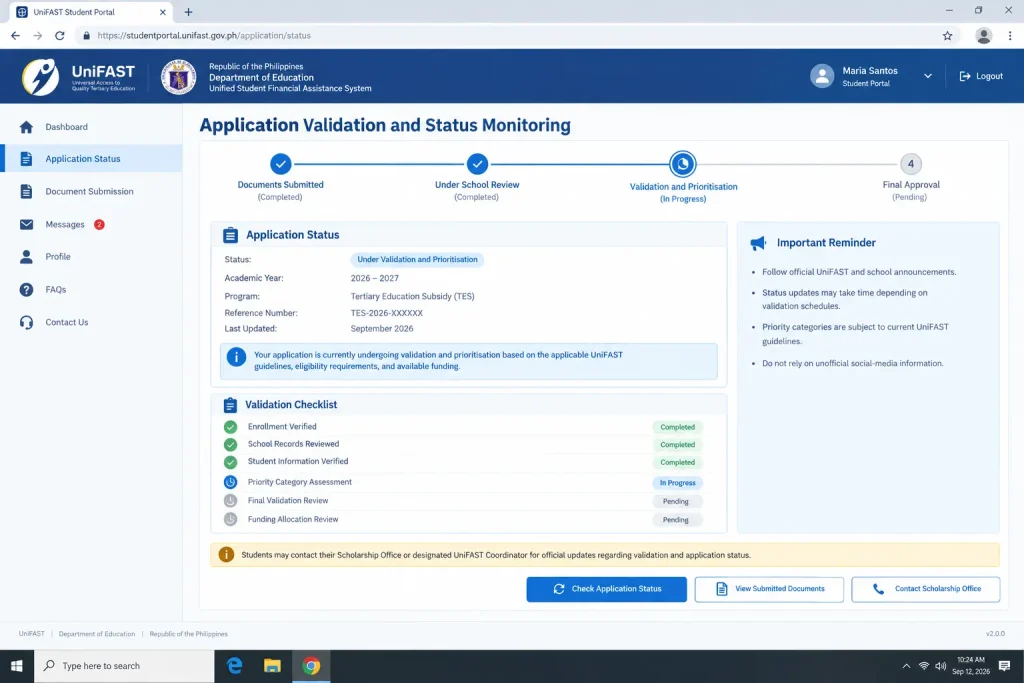
How to Check Your UniFAST Scholarship Status
Students should understand the difference between checking general UniFAST programme information and checking the status of an individual application or beneficiary record. UniFAST publishes official programme guidelines, issuances, announcements, and other updates, while the student’s HEI may handle document collection, validation, and student-level processing. If you have already submitted your documents, your school’s designated scholarship or UniFAST coordinator should normally be your first contact for application-related concerns.
Where Should You Check?
For individual UniFAST scholarship or financial assistance concerns, students can check their school’s official student or scholarship portal, contact the appropriate scholarship or financial-aid office, or inquire with the relevant CHED Regional Office. The official UniFAST website should also be used for programme announcements, guidelines, and issuances. The UniFAST Guidelines and Issuances page provides official programme documents, including updated and previous issuances related to the Tulong Dunong Program (TDP) and Tertiary Education Subsidy (TES).
- Check your school’s official portal
- Contact the scholarship or financial-aid office
- Review official UniFAST and CHED updates
What If Your Name Is Not Yet Listed?
If your name is not yet shown on a beneficiary or status list, this does not automatically mean that your application has been rejected. Your record may still be undergoing validation, your school may still be completing its submission, or some enrolment or document information may need updating. Contact your HEI and ask about the status of your submission, whether your enrolment information is complete, and whether any documents are still required. Keep your Certificate of Registration or Enrolment and other submission records available in case the school needs to verify your information.
- Ask whether your information was submitted
- Confirm that your enrolment record is complete
- Check for missing documents or updated notic
How UniFAST Assistance Is Paid or Applied
The way UniFAST assistance is provided depends on the specific programme and its applicable rules. Not all UniFAST benefits work like a traditional scholarship with a regular cash allowance. Free Higher Education (FHE) generally provides eligible students in qualified SUCs and LUCs with exemptions from tuition and covered school fees, while the Tertiary Education Subsidy (TES) provides grant-in-aid support to eligible and prioritised students. Current official information lists ₱20,000 per academic year for eligible SUC/LUC students and ₱27,000 per academic year for eligible students in private HEIs, subject to prioritisation and available government funds.
- FHE mainly provides fee exemptions
- TES provides grant-in-aid support
- TES amounts depend on the applicable category
- Benefits are subject to eligibility and funding
UniFAST Scholarship vs. Tulong Dunong Program
The terms UniFAST scholarship and Tulong Dunong Program (TDP) are sometimes used together in online searches, but they do not refer to the same thing. UniFAST is the broader government financial assistance framework, while TDP is a specific subsidy programme under the Tertiary Education Subsidy (TES) framework. The current official information lists ₱7,500 per regular semester for qualified TDP beneficiaries, subject to applicable prioritisation rules and available funds. New applicants generally need to be Filipino citizens, have a combined household gross income of no more than ₱400,000, be enrolled in a first undergraduate degree, satisfy the programme requirements, and not already receive TES, CHED Scholarship Programs, or other restricted national government-funded student financial assistance.
- ₱7,500 per regular semester
- Filipino citizenship is required
- Household gross income must be ≤ ₱400,000
- Other government-funded aid restrictions may apply
Common Problems Students Should Avoid
| Common Problem | Why It Can Cause Issues | What Students Should Do |
|---|---|---|
| Relying on an Old Scholarship Requirements List | UniFAST programmes and requirements may be updated from one year to another. Older articles or scholarship lists may no longer reflect the current rules. | Check the latest official UniFAST guidelines and issuances, especially updates related to TES and TDP, before submitting documents. |
| Assuming Every Student Receives the Same Amount | UniFAST programmes provide different types and amounts of assistance depending on the programme, institution, student category, and applicable rules. | Check the specific programme requirements and current benefit amounts that apply to your situation. |
| Applying Through an Unofficial Website | Some websites may incorrectly claim to offer or process a UniFAST scholarship application. Sharing personal information with an unknown website can create unnecessary risks. | Start with the official UniFAST government website and use verified school or government channels. |
| Missing School Deadlines | Your HEI may set its own schedule for collecting documents, validating information, or submitting student records. Missing these dates can affect your processing. | Regularly check your school email, student portal, scholarship office announcements, and other official communication channels. |
Quick UniFAST Application Checklist
Before contacting your school’s scholarship or financial-aid office, make sure you have completed the following:
- Confirm that your institution is covered by the relevant UniFAST programme.
- Check whether you meet the applicable citizenship and academic requirements.
- Obtain your current Certificate of Registration or Certificate of Enrolment.
- Prepare all programme-specific supporting documents.
- Determine whether you may qualify under an applicable priority category.
- Ask your HEI about its application and validation schedule.
- Submit your documents through the official school process.
- Keep proof of submission and copies of your documents.
- Monitor official school announcements for updates.
- Review the latest UniFAST guidelines before relying on older information.
UniFAST Scholarship 2026: Important Things to Know
Before applying for financial assistance, students should understand that UniFAST scholarship is a broad term commonly used when searching for different government-funded education assistance programmes. UniFAST is not a single scholarship with one fixed benefit or application process. The type and amount of assistance a student may receive depend on the specific programme, eligibility requirements, institution, prioritisation rules, and available government funding.
The official UniFAST information identifies major programmes implemented under Republic Act No. 10931, including Free Higher Education (FHE), Tertiary Education Subsidy (TES), Student Loan Program – Short Term, and Free Technical-Vocational Education and Training (FTVET). Each programme has different rules and benefits, so students should identify the appropriate programme and review its latest requirements before applying.
Can You Receive More Than One Government Education Benefit?
Receiving more than one government-funded education benefit is not automatically allowed, as some UniFAST programmes have specific restrictions on beneficiaries receiving other forms of national government student assistance. For example, the Tulong Dunong Program (TDP) requires applicants to meet conditions concerning other financial assistance, including restrictions involving TES, CHED Scholarship Programs, and other national government-funded student assistance programmes.
The TES guidelines also contain provisions concerning students who are already beneficiaries of TDP, CHED Scholarship Programs, or other national government-funded financial assistance, subject to applicable rules and exceptions. Students should therefore disclose existing scholarships, subsidies, or other government assistance when required during the application process and carefully check the programme guidelines instead of assuming that multiple benefits can automatically be combined.
What Happens After You Submit Your UniFAST Documents?
After you submit your UniFAST documents through your school, the information is reviewed and processed according to the requirements of the specific financial assistance programme. For TES, eligibility and prioritisation are assessed based on the current UniFAST guidelines. For Academic Year 2026–2027, priority includes eligible enrolled students from households listed in the latest DSWD Listahanan, along with other qualified groups such as children or dependants of active solo parents and members of Indigenous Cultural Communities or Indigenous Peoples, with applicable ranking based on household per-capita income.
- Documents are checked and validated
- Eligibility is assessed under the programme rules
- Qualified students are prioritised based on current guidelines
- Assistance depends on available funding and programme allocation
What Is the Difference Between FHE, TES and TDP?
Free Higher Education (FHE), Tertiary Education Subsidy (TES), and Tulong Dunong Program (TDP) are sometimes confused because all are connected to government financial assistance for tertiary students. However, they serve different purposes.
| Programme | Main Purpose | Current Information |
|---|---|---|
| Free Higher Education (FHE) | Provides eligible students with free tuition and covered school fees | Available in qualified SUCs and CHED-recognised LUCs |
| TES | Provides grant-in-aid assistance to prioritised tertiary students | ₱20,000 per academic year for eligible SUC/LUC students and ₱27,000 for eligible PHEI students |
| TDP | Helps eligible students meet part of their tertiary education and education-related costs | ₱7,500 per regular semester, subject to prioritisation and available funds |
The official FHE page states that qualified students receive free tuition plus 13 other school fees, while TES and TDP have separate eligibility, prioritisation, and documentary requirements.
Can Technical-Vocational Students Receive UniFAST Assistance?
The programme is intended for eligible learners enrolled in their first post-secondary TESDA-registered TVET programme, subject to the applicable conditions, prioritisation rules, and availability of funds. The official UniFAST information indicates that learners who already hold National Certificate III or higher are generally not eligible, except in the specified bundled-programme situation.
FTVET assistance can include tuition and other eligible training support. The official UniFAST materials also identify benefits such as:
- National competency assessment
- Instructional materials
- Uniform allowance
- Accident insurance
Because FTVET is implemented through TESDA in state-run technical-vocational institutions, students should follow the instructions provided by the appropriate institution and verify current programme requirements before enrolling.
Practical Tips for a UniFAST Scholarship Application
1. Start With Your School
Your school is usually the best starting point for a UniFAST scholarship or financial assistance application. Contact the appropriate office to confirm which UniFAST programme is available, whether your institution is covered, when applications or validation are open, and where you should submit your documents. The school can also provide the contact details of its designated UniFAST coordinator or focal person.
- Ask which UniFAST programme applies
- Confirm your school’s eligibility
- Check application deadlines
- Contact the designated coordinator
2. Use the Latest Guidelines
Always check the latest official UniFAST guidelines before preparing your application. Requirements and procedures may change between academic years, so avoid depending only on old screenshots, outdated scholarship lists, or social-media posts. Use current programme guidelines to confirm the documents, eligibility conditions, and application procedures that apply to you.
- Check the latest official guidelines
- Avoid outdated scholarship posts
- Confirm current requirements
- Follow the latest procedures
3. Keep Your Enrolment Documents
Keep a copy of your Certificate of Registration (COR) or Certificate of Enrolment (COE) because these documents may be required to prove your current enrolment status. For the Tulong Dunong Program (TDP), the requirements identify a certified true copy or electronically generated COE/COR showing the number of units as proof of enrolment.
- Keep your COR or COE
- Make sure enrolment details are correct
- Keep digital and printed copies
- Follow your school’s document requirements
4. Keep Your Information Consistent
Before submitting your application, carefully check that your personal and academic information matches your official school records. Your name, course, year level, student number, and enrolment status should be accurate and consistent. If you notice an error, contact the appropriate school office and request a correction before validation.
- Check your personal information
- Verify your course and year level
- Confirm your student number
- Correct errors before submission
5. Watch for Official Announcements
Regularly check official UniFAST resources for programme announcements, updated guidelines, issuances, participating institutions, and other important information. Avoid relying on forwarded messages or unverified social-media posts, especially when they contain application deadlines, benefit amounts, or eligibility claims. Official sources should be your main reference for UniFAST updates.
- Follow official UniFAST announcements
- Check updated programme information
- Verify application deadlines
- Avoid unverified scholarship messages
Final Checklist Before You Apply
Before submitting your UniFAST-related documents, take a few minutes to verify the following:
- Filipino citizenship: Confirm that you meet the programme’s citizenship requirement.
- School eligibility: Check that your institution is covered by the relevant programme.
- Degree status: Verify whether you are pursuing your first undergraduate degree where required.
- Enrolment: Prepare your current COR or COE.
- Income documents: Obtain the required proof if your programme uses income-based criteria.
- Special category: Prepare PWD, Indigenous Peoples, or other supporting documents where applicable.
- Existing assistance: Declare other government-funded financial assistance when required.
- Current guidelines: Check the latest UniFAST issuance rather than relying on an old checklist.
- School process: Follow your HEI’s official submission instructions.
- Proof of submission: Keep copies of all documents and submission confirmations.
- Status: Follow up through your school’s authorised scholarship or financial-aid office.
Frequently Asked Questions About UniFAST Scholarship
Final Takeaway
The term UniFAST scholarship broadly refers to several government financial assistance programmes rather than one universal scholarship. Students should first identify the programme that fits their situation and then review its eligibility requirements, available benefits, required documents, prioritisation rules, and application process. Free Higher Education (FHE) may provide eligible students in qualified SUCs and CHED-recognised LUCs with tuition and covered school-fee exemptions, while Tertiary Education Subsidy (TES) and the Tulong Dunong Program (TDP) provide financial assistance to students who meet their respective requirements.
For 2026 applicants, it is important to check the latest programme information before applying because guidelines and implementation procedures may change. Students should start by contacting their school’s authorised scholarship or financial-assistance office, prepare the required documents, and verify current eligibility requirements, benefit amounts, deadlines, and application instructions through the official UniFAST website before submitting personal information.