Online Theoretical Driving Course (OTDC) Philippines 2026: Registration, Requirements, Modules & Certificate

If you are planning to apply for an LTO Student-Driver’s Permit, completing the required Online Theoretical Driving Course (OTDC) can be an important step before moving forward with your application. The OTDC provides theoretical training through an online platform and covers essential topics such as traffic rules, road signs, defensive driving, road safety, driver responsibilities, and land-transportation laws.
The OTDC Philippines platform provides access to a 15-hour theoretical driving course through an online learning system. Applicants can study the required topics remotely, complete the applicable learning activities and assessments, and follow the certificate process through an LTO-accredited driving-school partner.
You can visit the official OTDC Philippines platform at OTDC.PH. However, completing the OTDC should not be confused with completing the entire Student-Driver’s Permit application. After finishing the theoretical course, applicants still need to satisfy the applicable LTO requirements and complete the separate permit application process.
Quick Answer: The Online Theoretical Driving Course (OTDC) is a 15-hour online theoretical driving program offered through an LTO-accredited driving-school process. Students learn traffic regulations, road safety, defensive driving, vehicle safety, driver responsibilities, and other required topics before proceeding with the applicable Student-Driver’s Permit requirements.
What Is the Online Theoretical Driving Course?
The Online Theoretical Driving Course (OTDC) is an online training program designed to teach aspiring drivers the basic knowledge they need before operating a motor vehicle. Instead of teaching practical vehicle handling, the course focuses on the theoretical side of driving, including traffic regulations, road signs, safe driving practices, defensive driving, and driver responsibilities.
The OTDC platform describes its program as a 15-hour LTO-approved Theoretical Driving Course delivered through an online learning environment. Applicants normally enrol through an LTO-accredited driving-school partner, receive the necessary account credentials, complete the required online lessons and assessments, and then follow the applicable certificate procedure with the driving school.
This means the OTDC should not be considered a substitute for practical driving lessons. Its primary purpose is to provide the theoretical knowledge required before an applicant proceeds to the next stages of the licensing process.
Why Is OTDC Important for a Student-Driver’s Permit?
The theoretical driving course is an important requirement for applicants seeking an LTO Student-Driver’s Permit. The required training helps new drivers understand traffic laws, road safety principles, and the responsibilities involved in using public roads.
The OTDC Philippines program can introduce students to topics such as:
- Basic driving principles
- Traffic rules and regulations
- Road signs and traffic signals
- Pavement markings
- Right-of-way rules
- Defensive driving techniques
- Hazard identification
- Vehicle safety
- Driver responsibilities
- Emergency situations
- Vehicle breakdown procedures
- Land-transportation laws
The OTDC curriculum also covers areas such as introductory driving concepts, road and traffic rules, pre-driving orientation, defensive driving, basic motor-vehicle maintenance, emergency and breakdown procedures, driver duties, and special laws related to land transportation.
OTDC Requirements: What Do You Need?
Before enrolling in the Online Theoretical Driving Course, prepare the personal information and documents that may be required during registration. The exact requirements can depend on your applicant category and the procedures followed by the selected LTO-accredited driving school. Visit Homepage.
| Category | Requirements / Information |
|---|---|
| Filipino Applicant | Must generally be at least 16 years old to apply for a Student-Driver’s Permit. |
| Foreign Applicant | Must generally be at least 18 years old, subject to applicable LTO residency or stay requirements. |
| Physical and Mental Fitness | Applicants must be physically and mentally fit to drive. |
| Literacy Requirement | Applicants should be able to read and write in Filipino or English. |
| Theoretical Driving Course | Applicants must complete the required Theoretical Driving Course (TDC) before applying for the Student-Driver’s Permit. |
| Traffic Record | Applicants must comply with applicable LTO requirements regarding unsettled traffic violations. |
| Proof of Identity | A PSA Birth Certificate or another accepted proof of identity may be required. |
| Valid ID | A valid government-issued ID may be required during registration or the Student-Driver’s Permit application. |
| Email Address | An active email address may be needed for OTDC registration, account verification, and course-related communication. |
| Mobile Number | A working mobile phone number may be required during registration. |
| LTMS Client ID | An active LTMS Client ID may be needed for the applicable LTO process. |
| Parental Consent | Applicants who are minors may need parental consent together with the required identification documents from the parent or legal guardian. |
| Provider Requirements | OTDC registration requirements can vary depending on the applicant category and the selected LTO-accredited driving school. Applicants should confirm the current requirements with their chosen provider before registration or payment. |
| Important Note | OTDC enrolment requirements and Student-Driver’s Permit requirements are not necessarily identical. Applicants should check the latest instructions from the Land Transportation Office (LTO) before completing the process. |
How to Register for OTDC.PH
The OTDC Philippines registration process begins through the online platform, but the course is connected with participating LTO-accredited driving schools. The official OTDC process generally involves selecting an accredited partner, completing enrolment, receiving login credentials, finishing the online training, and following the applicable certificate procedure.
Step 1: Visit the Official OTDC Website
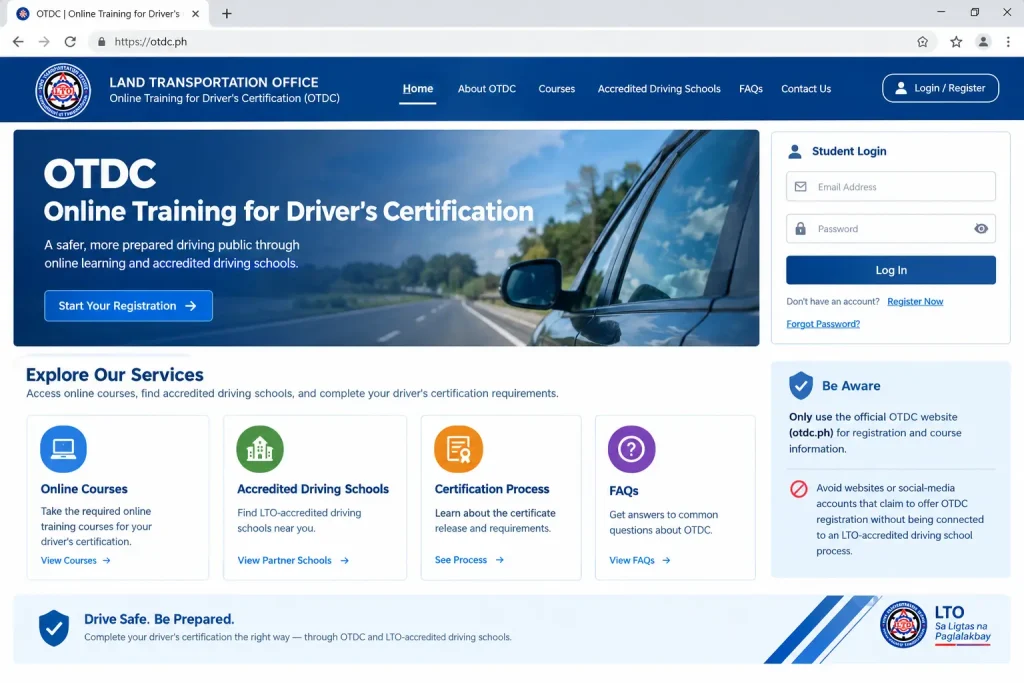
Start by opening the official OTDC platform:
Use the official website when checking course information and registration instructions. Avoid websites or social-media accounts that claim to offer OTDC registration without confirming that they are connected with an appropriate LTO-accredited driving-school process.
Once on the website, review the available course information and follow the registration or enrolment instructions provided.
Step 2: Select an LTO-Accredited Driving School Partner
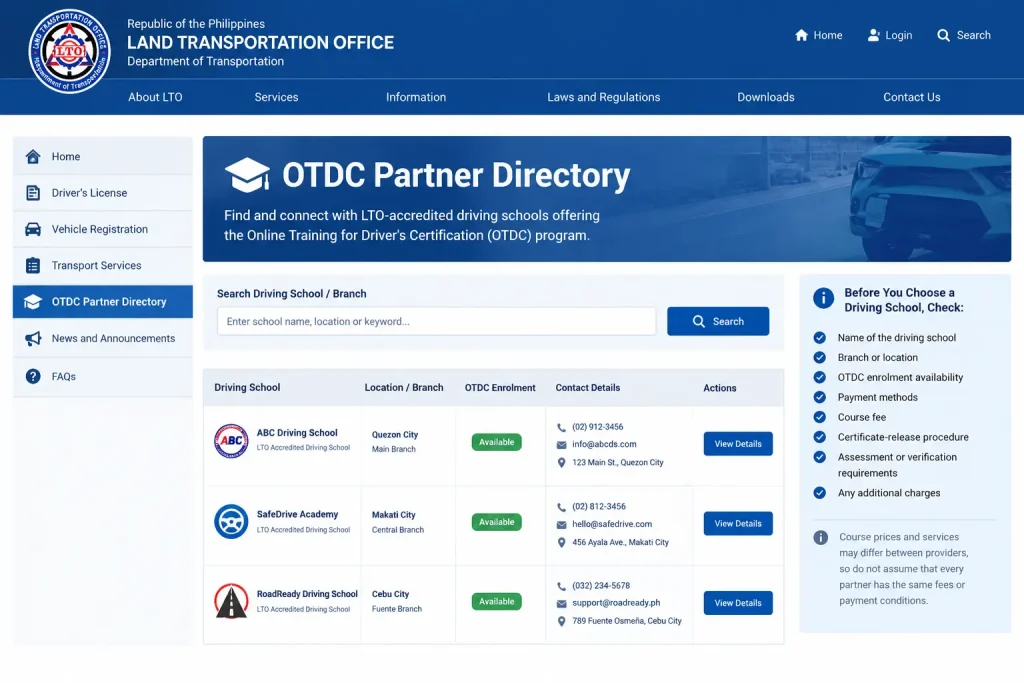
The OTDC system works with partner driving schools that facilitate enrolment and the applicable certificate process.
You can check the available partners through the official directory:
Before selecting a provider, consider checking:
- Name of the driving school
- Branch or location
- OTDC enrolment availability
- Payment methods
- Course fee
- Certificate-release procedure
- Assessment or verification requirements
- Any additional charges
Course prices and services may differ between providers, so do not assume that every partner has the same fees or payment conditions.
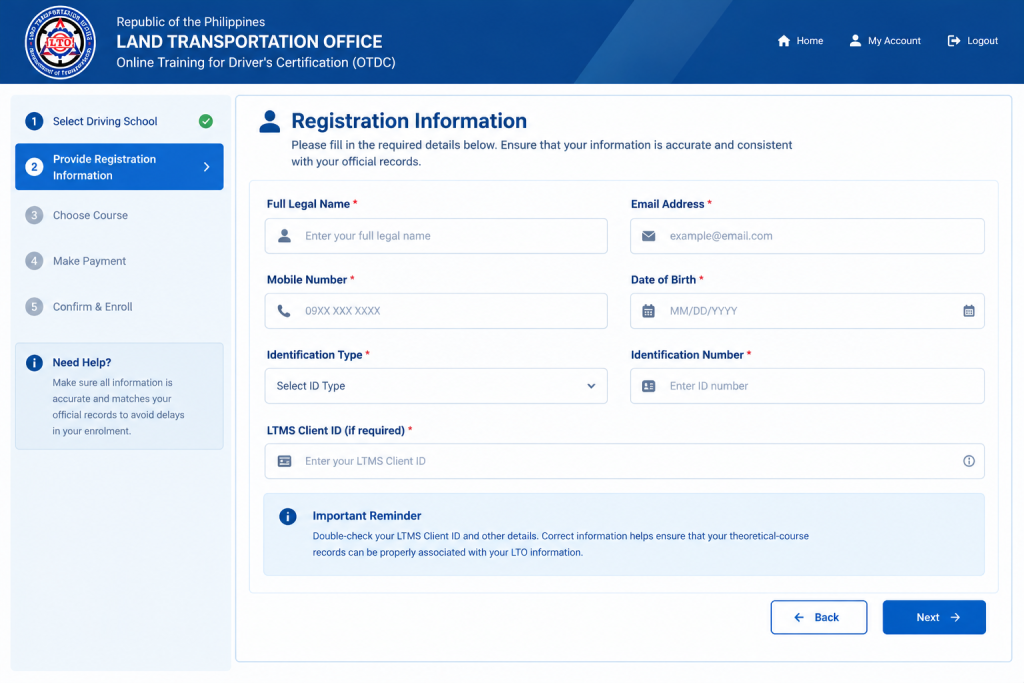
Step 3: Provide Your Registration Information
After selecting a partner, submit the information requested during enrolment. Make sure that your details are accurate and consistent with your official records.
You may be asked for information such as:
- Full legal name
- Email address
- Mobile number
- Date of birth
- Identification details
- LTMS Client ID
Pay special attention when entering your LTMS Client ID, if requested. Correct information helps ensure that your theoretical-course records can be properly associated with your LTO information.
Before submitting the registration, review the information carefully for spelling mistakes or incorrect details.
Step 4: Pay the Applicable Course Fee
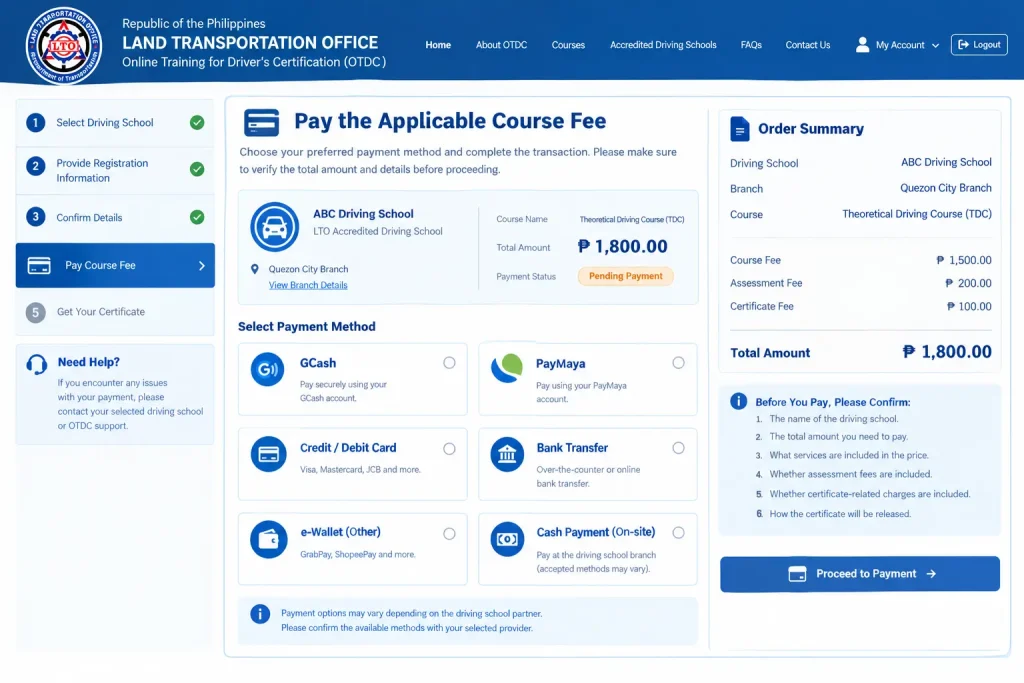
The OTDC platform supports available online and offline payment methods, although the specific options may depend on the driving-school partner you select.
Before making a payment, confirm:
- The name of the driving school.
- The total amount you need to pay.
- What services are included in the price.
- Whether assessment fees are included.
- Whether certificate-related charges are included.
- How the certificate will be released.
Course prices can change, so avoid relying on an old fee displayed on another website or social-media post. Confirm the current price directly with your selected OTDC partner.
Tip: Keep your payment confirmation or receipt until you have completed the course and received confirmation of your certificate.
What Happens After OTDC Registration?
After your registration and payment have been processed, you can receive the login information needed to access the online learning platform. According to the OTDC course information, students may receive their username and password through email.
Once you receive your credentials, log in and begin the required lessons.
The online course is designed to allow students to study through an internet-connected device. The platform may include learning materials, checkpoint assessments, examinations, and reviewer resources to help students understand and prepare for the required evaluation.
Make sure you complete all required lessons and assessments according to the instructions shown in your account.
OTDC Course Modules and Subjects
The Online Theoretical Driving Course covers multiple areas of driving knowledge. The objective is to give new drivers a broad understanding of safe road use rather than focusing only on one particular driving skill.
| OTDC Module | What You Learn |
|---|---|
| Introduction to Driving | Fundamental concepts and basic principles of driving |
| Road and Traffic Rules | Traffic regulations and proper road-use practices |
| Pre-Driving Orientation | Important checks and preparation before driving |
| Defensive Driving | Risk awareness and techniques for safer driving |
| Vehicle Maintenance | Basic vehicle safety and maintenance knowledge |
| Emergencies and Breakdowns | Appropriate responses to common road emergencies and vehicle problems |
| Driver Duties and Responsibilities | Proper driver behaviour and responsibilities on the road |
| Special Laws | Relevant land-transportation laws and regulations |
Introduction to Driving
This section provides an overview of driving fundamentals. New applicants can learn about the basic principles involved in becoming a responsible road user and the importance of following traffic regulations.
Road and Traffic Rules
Traffic rules form an important part of the theoretical course. Students learn about proper road use, traffic regulations, road signs, signals, markings, and other rules that help maintain order and safety.
Pre-Driving Orientation
Before operating a vehicle, drivers need to understand basic preparation and safety procedures. This module introduces concepts that can help applicants develop safer habits before starting a trip.
Defensive Driving
Defensive driving focuses on identifying potential risks and responding appropriately to hazards. Students learn why drivers should remain alert, anticipate possible dangers, maintain appropriate control, and make safer decisions.
Vehicle Maintenance
Basic vehicle knowledge is also part of theoretical driver education. Students can learn about vehicle safety, basic maintenance concepts, and the importance of ensuring that a vehicle is suitable for road use.
Emergencies and Breakdowns
Drivers may encounter unexpected situations while travelling. This part of the course introduces appropriate responses to emergencies, vehicle breakdowns, and other situations that may require caution or assistance.
Driver Duties and Responsibilities
Being a licensed driver involves more than knowing how to control a vehicle. Drivers are expected to understand their responsibilities toward passengers, pedestrians, other motorists, and the wider road community.
Land-Transportation Special Laws
The course also introduces applicants to applicable laws and regulations governing land transportation. Understanding these rules can help new drivers make better decisions and avoid violations.
Understanding the OTDC Learning Modules
The Online Theoretical Driving Course (OTDC) covers several important areas of driving knowledge. The lessons are designed to help new drivers understand Philippine traffic rules, road safety practices, driver responsibilities, and common situations they may encounter on the road.
The course is not focused on practical vehicle operation. Instead, it gives learners the theoretical knowledge they should understand before moving on to practical driving and the next stages of the licensing process.
1. Introduction to Driving
The introductory module establishes the basic foundation for learning how to become a responsible driver. It explains the role of a driver and why safety, awareness, and proper road behaviour are important.
Topics may include:
- Basic driving principles
- Responsibilities of a driver
- Road-safety concepts
- General licensing information
- Appropriate behaviour while operating a vehicle
Understanding these fundamentals can make it easier to follow the more detailed topics covered in later modules.
2. Road and Traffic Rules
Traffic regulations are a major part of the OTDC Philippines curriculum. This section introduces learners to the rules that govern how motorists should use roads and interact with pedestrians, cyclists, and other road users.
Depending on the course material, you may study topics such as:
- Traffic laws and regulations
- Proper lane usage
- Intersections
- Right-of-way
- Overtaking
- Speed management
- Safe road behaviour
These rules should not be viewed simply as information to memorise for an examination. They provide the foundation for making safer decisions when you eventually begin driving.
3. Pre-Driving Orientation
Safe driving begins before the vehicle starts moving. The pre-driving orientation introduces learners to important preparations that should be completed before operating a vehicle.
This may include checking the general condition of the vehicle, preparing yourself for the trip, and being aware of road, weather, and surrounding conditions.
OTDC Tip: Pay close attention to safety-related examples throughout the lessons. Theoretical assessments may test how you would respond to a particular driving situation rather than simply asking you to recall a definition.
4. Defensive Driving
Defensive driving is another important component of the theoretical course. It teaches drivers to remain alert to potential hazards and avoid assuming that other road users will always make the correct decision.
Important areas may include awareness of:
- Other motorists
- Pedestrians
- Road conditions
- Weather conditions
- Possible hazards
- Safe following distances
- Unexpected road situations
For first-time drivers, defensive driving is particularly valuable because safe driving involves anticipating possible risks and responding appropriately.
5. Vehicle Maintenance
The OTDC curriculum also introduces basic motor-vehicle maintenance and safety. The objective is not to make students professional mechanics. Instead, learners gain basic knowledge about vehicle condition and why regular safety checks are important.
Understanding basic vehicle maintenance can help new drivers recognise potential problems and appreciate why an unsafe or poorly maintained vehicle should not be used on public roads.
6. Emergencies and Breakdowns
Even careful drivers can experience unexpected problems while travelling. For this reason, the OTDC includes lessons covering emergencies and vehicle breakdowns.
This section helps learners understand how they should respond when an unexpected situation occurs.
Possible topics include:
- Vehicle breakdowns
- Road emergencies
- Unexpected hazards
- Basic safety responses
- Appropriate actions during difficult situations
The objective is to help new drivers remain calm, aware, and safety-conscious when something goes wrong.
7. Driver Duties and Special Laws
The curriculum also covers Driver’s Duties and Responsibilities and Land Transportation Special Laws. These subjects help learners understand that driving involves legal and personal responsibilities, not simply controlling a vehicle.
Drivers are expected to follow applicable transportation laws and behave responsibly toward pedestrians, passengers, and other road users.
The special-laws section is particularly useful because understanding the legal responsibilities associated with driving can help applicants avoid violations and develop better driving habits.
How to Get the OTDC Certificate
1. Register for the Online Theoretical Driving Course
To get your OTDC certificate, you must first register for the Online Theoretical Driving Course through an LTO-accredited driving school or OTDC partner. Provide the required personal information and your LTMS Client ID, then complete the registration and payment process according to your selected provider’s instructions.
- Visit the official OTDC platform and choose an accredited partner.
- Provide your required personal information and LTMS Client ID.
- Complete the registration and applicable course payment.
2. Complete All Required Course Modules
After registration, log in to your OTDC account using the credentials provided by your course provider and complete the required theoretical driving modules. The course covers important topics such as traffic rules, road signs, defensive driving, vehicle safety, emergencies, driver responsibilities, and applicable transportation laws.
- Complete all required OTDC learning modules.
- Study the lessons, road signs, traffic rules, and safety topics carefully.
- Make sure you meet the provider’s required course completion time or attendance rules.
3. Take and Pass the Required Assessment
After completing the course lessons, you may need to take the required OTDC assessment or final examination. The assessment checks your understanding of the topics covered during the theoretical driving course, so reviewing the modules before taking the test can help you achieve the required passing score.
- Review the course lessons before taking the assessment.
- Complete the required OTDC final assessment.
- Meet the passing requirement set by your course provider.
4. Complete the Evaluation and Certificate Process
Once you successfully complete the required lessons and assessment, follow your driving school’s instructions for course completion and certificate issuance. The provider will verify that you have fulfilled the necessary requirements before making your OTDC/TDC certificate available.
- Complete any required course evaluation.
- Wait for your completion record to be verified.
- Follow the provider’s instructions to receive or access your certificate.
5. Keep Your OTDC Certificate for Your LTO Application
After receiving your OTDC certificate, keep a clear copy for your records because it may be required when proceeding with your Student-Driver’s Permit application. Remember that completing the OTDC does not automatically give you a driver’s license or Student-Driver’s Permit; you must still complete the applicable LTO requirements and application process.
- Save a digital copy of your OTDC certificate.
- Keep a printed copy if your application requires one.
- Proceed with the applicable LTO Student-Driver’s Permit requirements.
How to Complete Your OTDC Online Lessons
After receiving your account credentials, work through the OTDC online lessons in an organised manner. Rather than rushing through the entire course, complete each section and assessment according to the instructions provided on your account.
A simple progression is:
Log in → Study the lesson → Complete required activities → Take the assessment → Review your progress → Continue to the next module
Your OTDC dashboard should be the main place to check which lessons and activities have been completed and which ones still require attention.
Keep Your OTDC Login Details Safe
Your account contains information about your course progress, so do not share your username or password with other people.
Use the email address associated with your registration and maintain access to that email throughout the course. Important information such as login credentials, course notifications, or registration-related messages may be sent there.
If you experience a login problem, contact your driving-school partner or follow the support instructions provided by the OTDC platform.
Complete the Required Learning Material
It can be tempting to move quickly through the lessons, especially if you are already familiar with basic traffic rules. However, the purpose of the 15-hour theoretical driving course is to give new applicants a structured foundation in road safety and responsible driving.
Take time to understand the lessons instead of treating the course as an examination that only needs to be completed.
The theoretical driving course is an important component of the requirements associated with the LTO Student-Driver’s Permit process.
OTDC Assessments and Final Examination
Completing the lessons may not be the final step. Students may also need to complete assessments as part of the theoretical training process. The exact assessment method and procedures can depend on the current OTDC system and the LTO-accredited driving-school partner.
Before taking the final assessment, review the major topics covered throughout your course.
What Should You Review Before the Assessment?
Pay particular attention to:
- Traffic signs and signals
- Traffic regulations
- Right-of-way rules
- Defensive driving
- Driver duties and responsibilities
- Basic vehicle safety
- Emergency situations
- Road safety practices
- Relevant transportation laws
If a particular lesson was difficult during your initial study, go back to that section and review it before attempting the final assessment.
What Is the OTDC Passing Score?
The available OTDC information indicates an 80% passing grade for the applicable final assessment. However, assessment procedures can change, and implementation may depend on the accredited driving-school partner.
For this reason, follow the current instructions provided through your OTDC account or selected driving school.
Do not rely solely on an old screenshot, social-media post, or information provided by another applicant. Your current provider should be your primary source for the assessment requirements attached to your enrolment.
Getting Your TDC Certificate of Completion
After completing the required theoretical lessons and successfully meeting the applicable assessment requirements, the next important step is obtaining your Theoretical Driving Course Certificate of Completion, commonly called the TDC Certificate.
This certificate serves as proof that you have completed the required theoretical driving training.
The OTDC process explains that students who complete the online component may need to return to their selected driving-school partner to complete the applicable certificate procedure.
What Happens After You Pass?
The general process can be summarised as follows:
- Complete all required OTDC lessons.
- Finish the applicable assessments.
- Meet the required passing standard.
- Follow your driving school’s certificate-release instructions.
- Confirm that your course completion has been properly recorded.
- Keep your TDC completion record for the next stage of the LTO process.
Keep your certificate and related records in a safe location. Even when information is recorded electronically, retaining your own documentation can be useful for future transactions.
How OTDC Connects With the LTO LTMS Portal
The LTMS Portal is the Land Transportation Management System used by the LTO for various licensing and transportation-related transactions.
Applicants should make sure that their personal information and LTMS details are correct before proceeding with their Student-Driver’s Permit application.
Official LTO LTMS Portal: portal.lto.gov.ph
The LTO has procedures requiring accredited driving institutions to record relevant theoretical driving-course information using the applicant’s LTMS Client ID. This makes it important to provide the correct LTMS information when required during your driving-course registration.
Important: Completing the OTDC does not automatically issue an LTO Student-Driver’s Permit. The Student-Driver’s Permit is a separate LTO transaction with its own eligibility requirements and application procedure.
Applying for an LTO Student-Driver’s Permit After OTDC
Once you have completed the required theoretical driving training, you can proceed to the applicable Student-Driver’s Permit process.
The LTO requires applicants to provide the necessary proof of identity and age, evidence of theoretical driving-course completion, and other documents applicable to their situation.
Basic Process
The overall process can be viewed as:
Complete OTDC → Obtain TDC Certificate → Prepare LTO Requirements → Access LTMS → Apply for Student-Driver’s Permit → Complete the LTO Transaction
Before going to an LTO office, check the latest requirements, fees, appointment instructions, and application procedures. Government requirements can be updated, so information from an older guide may no longer be accurate.
What to Bring for the Student-Driver’s Permit Process
The documents you need can depend on your age, citizenship, and individual circumstances. Prepare the applicable documents before starting your LTO transaction.
A general preparation checklist may include:
| Document or Information | Purpose |
|---|---|
| TDC Certificate | Evidence of theoretical driving-course completion |
| PSA Birth Certificate | Proof of age or identity when applicable |
| Valid Government ID | Identification |
| Medical Certificate | Required medical documentation for the LTO transaction |
| LTMS Information | Used for your LTO licensing record |
| Parental Consent | Applicable to qualified applicants aged 16–17 |
The exact requirements should be confirmed through the latest LTO Citizen’s Charter or official instructions before your application because government procedures may be revised.
Common OTDC Mistakes to Avoid
Preparing your information properly can help prevent unnecessary delays when completing an Online Theoretical Driving Course.
1. Registering Through an Unverified Website
Online searches may show websites or social-media pages claiming to provide OTDC services. Before registering or paying, verify that you are using the official OTDC platform or dealing with an appropriate LTO-accredited driving-school partner.
Official OTDC: otdc.ph
2. Entering the Wrong LTMS Client ID
Your LTMS Client ID can be important when your theoretical-course information is recorded for the LTO process. Carefully check the number before submitting your registration.
A single incorrect digit could create problems when your records need to be matched.
3. Assuming All Driving Schools Follow the Same Procedure
Different partner schools may have their own arrangements for enrolment, payment, assessments, and certificate release.
Before paying, ask your selected provider what process applies specifically to your registration.
4. Leaving the Course Until the Last Minute
Although the course is delivered online, it is better not to wait until the final available period to complete everything.
Internet problems, login issues, technical errors, or account-related concerns can delay your progress. Completing the lessons steadily gives you more time to resolve unexpected problems.
5. Losing Your TDC Certificate
After receiving your certificate, keep both physical and digital copies whenever possible.
Your certificate or completion information may be needed during the next stage of your licensing process, so keeping your records organised is a good practice.
6. Treating OTDC as an Exam-Only Requirement
The purpose of the OTDC is to provide theoretical knowledge that can help prepare you for safer driving.
Instead of memorising answers temporarily, try to understand the reason behind traffic rules, defensive-driving principles, and driver responsibilities. This knowledge can become useful once you move from theory to practical driving.
OTDC Completion Checklist
Before proceeding to the next stage of the licensing process, review the following checklist:
- Registered through the appropriate OTDC process
- Selected an LTO-accredited driving-school partner
- Submitted accurate personal information
- Provided the correct LTMS Client ID when required
- Received your OTDC login credentials
- Accessed your online course account
- Completed the required theoretical lessons
- Completed the applicable activities and assessments
- Passed the required final assessment
- Followed your driving school’s certificate-release instructions
- Received or confirmed your TDC Certificate of Completion
- Prepared the remaining Student-Driver’s Permit requirements
- Checked the latest LTO instructions before applying
Going through this checklist can help you identify any unfinished requirement before starting your Student-Driver’s Permit application.
OTDC vs. Practical Driving Lessons
It is important to understand that theoretical and practical driving training serve different purposes.
| OTDC / Theoretical Training | Practical Driving Training |
|---|---|
| Focuses on driving knowledge | Focuses on actual vehicle operation |
| Traffic rules and regulations | Vehicle control |
| Road signs and traffic signals | Steering and manoeuvring |
| Defensive-driving concepts | Practical road experience |
| Driver responsibilities | Hands-on driving skills |
| Road-safety theory | Real-world driving practice |
| Transportation laws | Application of driving techniques |
The OTDC provides the theoretical foundation needed to understand traffic rules, road safety, and driver responsibilities. It does not replace practical driving instruction.
Once you move into practical training, you will need to develop actual vehicle-control skills and learn how to apply the knowledge gained from your theoretical course in real driving situations.
Understanding both parts is important: the OTDC teaches you the rules and principles, while practical driving helps you apply them safely behind the wheel.
What Happens After Completing OTDC?
Once you have completed the required 15-hour theoretical driving course and satisfied the applicable assessment requirements, the next step is to follow your selected driving school’s instructions for obtaining your TDC Certificate of Completion.
The certificate provides evidence that you have completed the required theoretical driving training. Based on the OTDC course process, students complete the online training and then follow the certificate procedure through their participating driving-school partner.
A simple way to understand the post-course process is:
Complete OTDC → Pass the required assessment → Obtain TDC Certificate → Verify your LTO/LTMS information → Prepare the remaining documents → Apply for a Student-Driver’s Permit
Remember that the TDC Certificate and Student-Driver’s Permit are not the same document. Completing OTDC does not automatically result in the issuance of a Student-Driver’s Permit.
How to Prepare for the LTO Student-Driver’s Permit
The Student-Driver’s Permit is processed through the Land Transportation Office (LTO). Before starting your application, review the latest LTO requirements because government procedures, documents, and application processes may be updated.
For Filipino applicants, the LTO generally requires a minimum age of 16 years old for a Student-Driver’s Permit. Applicants must also meet the applicable physical and mental fitness requirements and be able to read and write in Filipino or English.
Student Permit Preparation Checklist
Before proceeding with your application, prepare the documents and information that apply to your situation:
- TDC Certificate of Completion
- Acceptable proof of identity and age
- Valid identification document, when applicable
- Required medical documentation
- Active LTMS account and Client ID information
- Parental consent and supporting documents when required
- Any additional documents listed in the latest LTO requirements
Requirements can differ depending on the applicant’s circumstances, so check the current LTO instructions before travelling to an LTO office.
Visit the Official Land Transportation Office (LTO)
Tip: Do not rely entirely on an old checklist or information from another applicant. Always verify the current requirements before starting your Student-Driver’s Permit transaction.
How OTDC, LTMS and LTO Work Together
The terms OTDC, LTMS, and LTO can sometimes be confusing, especially for first-time applicants. Each one has a different role in the driving and licensing process.
| Service | Main Purpose |
|---|---|
| OTDC | Provides the required online theoretical driving training |
| Driving School | Facilitates accredited training and handles applicable enrolment and certificate procedures |
| LTMS | LTO’s online system for licensing records and selected transactions |
| LTO | Government agency responsible for land transportation regulation, licensing, and related services |
In simple terms, the OTDC provides the theoretical training, the driving-school partner facilitates the applicable course process, LTMS manages relevant LTO records and online services, and the LTO handles the official licensing transaction.
Your OTDC course is therefore one part of a larger process rather than the entire Student-Driver’s Permit application.
Why Is Your LTMS Client ID Important?
The LTMS Client ID is associated with your record in the LTO’s system. When enrolling in theoretical driving training, make sure the information you provide is accurate and matches your official records.
If there is an error in your name, date of birth, or other personal information, contact the appropriate driving-school partner or LTO support channel for guidance. Avoid creating duplicate accounts simply to work around an account or information problem.
OTDC Fees: How Much Does the Course Cost?
The cost of an Online Theoretical Driving Course is not necessarily the same for every applicant. Fees can vary depending on the driving-school partner, location, package, and services included.
The information provided for this guide indicates that some OTDC packages may commonly fall around ₱1,000 to ₱1,500. However, this should be treated only as a general reference rather than a fixed nationwide price.
Before paying, contact your selected driving-school partner and confirm the current total cost.
Questions to Ask Before Paying
Make sure you understand what your payment covers:
- What is the current total OTDC fee?
- Is the assessment included?
- Is the TDC certificate process included?
- Are there additional branch or administrative charges?
- Which payment methods are available?
- Where will the certificate be released?
- How long will the enrolment remain active?
- Are there any additional requirements before certificate release?
Important: OTDC fees can change. Always confirm the latest price directly with your selected partner before making a payment rather than relying on an outdated fee from another website or social-media post.
OTDC Troubleshooting Guide
Technical or account-related problems can occasionally occur during an online course. If you experience an issue, avoid creating multiple accounts or repeatedly registering without first checking with your provider.
What If I Cannot Log In?
First, verify that you are using the correct username and password provided during your OTDC enrolment. Also make sure that you are visiting the correct OTDC platform.
If your credentials still do not work, contact your driving-school partner or the appropriate OTDC support channel. They can help determine whether the problem is related to your account, credentials, or enrolment.
What If I Forget My Password?
If the platform provides a password-recovery option, use it to reset your account credentials.
If you cannot recover your password through the available option, contact the support channel associated with your registration.
Avoid creating another account without guidance, especially if your existing account is already associated with your course information or LTMS details.
What If My Course Progress Is Not Showing?
If your dashboard does not show the expected progress, first confirm that you have properly completed the lesson or assessment.
You can also:
- Refresh the page.
- Log out and sign in again.
- Check your internet connection.
- Confirm whether the lesson was actually submitted.
- Take a screenshot if the problem continues.
- Contact your driving-school partner for assistance.
Your provider can check the course record connected to your enrolment and advise you on the next step.
What If I Fail an Assessment?
If you do not pass an assessment on your first attempt, do not assume that you have to register for the entire course again.
Instead, follow the instructions provided by your OTDC partner regarding retakes, reviews, or additional assessment requirements. Procedures can vary depending on the provider.
Before attempting the assessment again, review the lessons covering the topics you found difficult.
Tips for Passing the OTDC Assessment
Preparing properly can make the theoretical assessment easier and help you understand the material rather than simply memorising answers.
Focus on Understanding the Rules
Pay close attention to major topics such as:
- Road signs
- Traffic signals
- Right-of-way rules
- Defensive driving
- Driver responsibilities
- Road-safety practices
- Emergency procedures
- Land-transportation laws
Try to understand how these rules apply to real driving situations. This can be more useful than memorising isolated answers.
Take Notes During the Course
Write down rules, definitions, or concepts that you find difficult.
Creating a short personal review sheet can make it easier to revisit important topics before taking the assessment.
You do not need to copy every lesson. Focus your notes on areas that you are likely to forget or topics that require additional review.
Don’t Rush Through the Lessons
Although completing the course is necessary for the licensing process, the purpose of OTDC is also to give new drivers a proper theoretical foundation.
Move through the lessons carefully and make sure you understand the information before progressing to the next section.
Review Your Weak Areas
If you struggle with a particular topic, return to that lesson before taking the final assessment.
For example, if right-of-way rules or road signs were difficult for you, spend additional time reviewing those subjects.
Understanding why a traffic rule exists and how it applies in a real situation is generally more valuable than memorising an answer temporarily.
Final OTDC Tip: Treat the course as preparation for becoming a safer driver, not simply as a requirement for obtaining a certificate. The knowledge you gain from the theoretical course can become the foundation for your practical driving experience.
Frequently Asked Questions About OTDC Philippines
Conclusion
The Online Theoretical Driving Course (OTDC) is an important part of the process for applicants preparing for an LTO Student-Driver’s Permit in the Philippines. Through the required theoretical training, students can learn about traffic rules, road signs, right-of-way, defensive driving, road safety, vehicle maintenance, emergencies, driver responsibilities, and relevant land-transportation laws.
Before registering, make sure your personal information and LTMS Client ID are accurate, choose an appropriate LTO-accredited driving-school partner, and confirm the current course fee and requirements. After completing the required 15-hour OTDC, finish the applicable assessment and follow the provider’s instructions for obtaining your TDC Certificate of Completion.
Remember that completing the OTDC Philippines course does not automatically give you a Student-Driver’s Permit. You must still meet the applicable LTO requirements and complete the separate permit application process. For the latest requirements, procedures, and official announcements, always verify information through the LTO and official OTDC sources before submitting an application or making a payment.