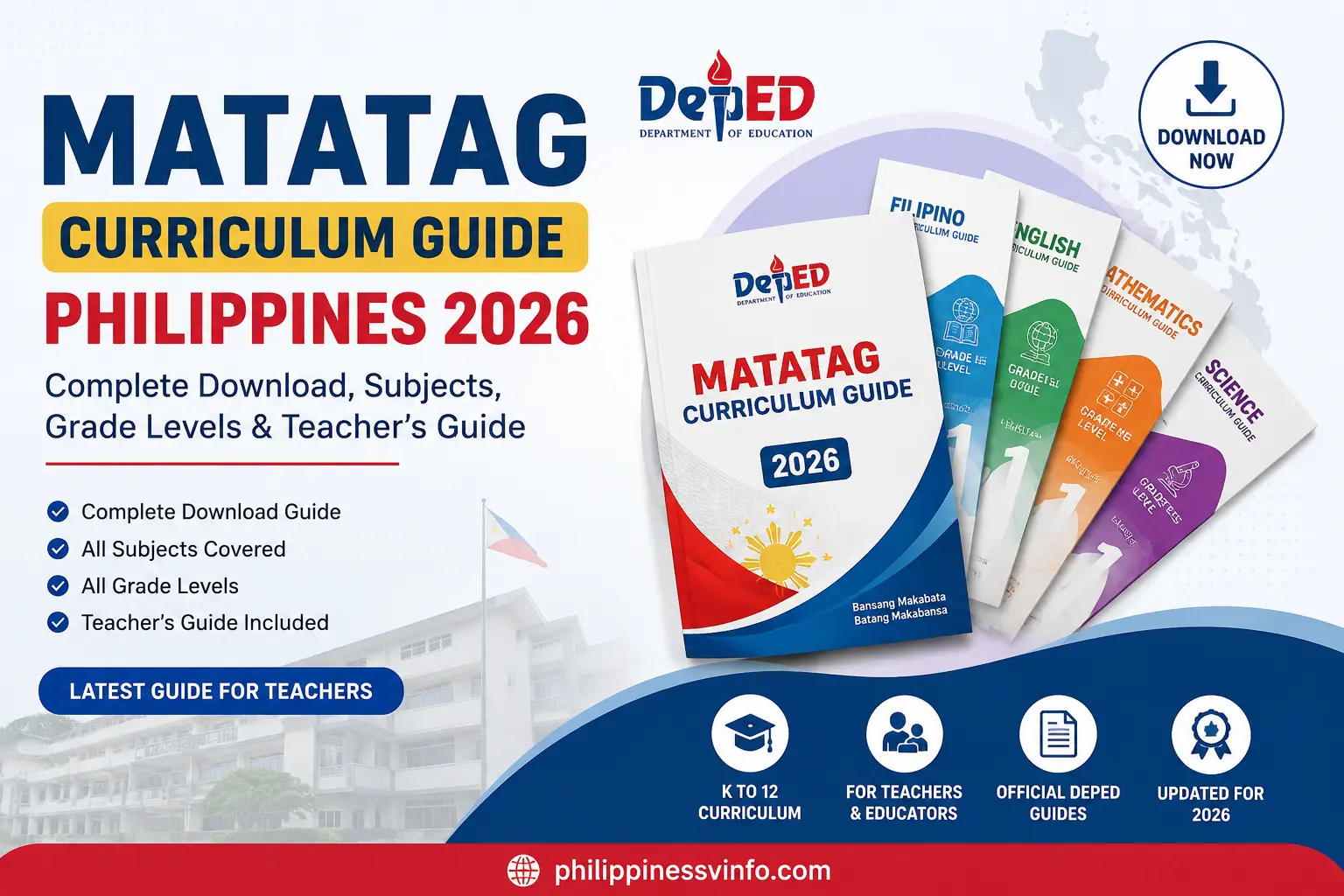
MATATAG Curriculum Guide Philippines 2026: Complete Download, Subjects, Grade Levels & Teacher’s Guide
The MATATAG Curriculum Guide Philippines 2026 is the official framework developed by the Department of Education (DepEd) to strengthen the quality of basic education across the country. The DepEd MATATAG Curriculum introduces a more focused and simplified approach to teaching by reducing unnecessary learning competencies and emphasising essential skills. As the official MATATAG Curriculum Guide, it provides teachers, school leaders, and education stakeholders with clear learning standards, subject competencies, and grade-level expectations that support effective classroom instruction. By simplifying the curriculum and focusing on essential learning outcomes, the guide helps educators deliver lessons more efficiently while giving students enough time to master core concepts.
The implementation of the portal also reflects DepEd’s commitment to improving learning outcomes following the challenges identified in previous years. Rather than covering an overloaded list of competencies, the MATATAG Curriculum DepEd framework prioritises foundational literacy, numeracy, critical thinking, and values formation. As schools continue adopting the new framework, the MATATAG Curriculum Guide serves as an essential reference for lesson planning, curriculum implementation, and ensuring consistent learning standards from Kindergarten through Grade 10.
What is the MATATAG Curriculum?
The MATATAG Curriculum is the revised K–10 basic education curriculum introduced by the Philippine Department of Education (DepEd) to provide a more focused, relevant, and learner-centred educational experience. If you are wondering what is MATATAG curriculum of DepEd, it is a redesigned framework that simplifies the previous K–12 curriculum by reducing unnecessary learning competencies while strengthening foundational learning in key subjects. Officially launched in 2023 and gradually implemented beginning in School Year 2024–2025, the DepEd MATATAG Curriculum aims to improve the quality of basic education and make classroom instruction more meaningful and manageable for both teachers and learners.
Under the DepEd MATATAG Curriculum, learners spend more time developing essential knowledge and practical skills in subjects such as English, Filipino, Mathematics, Science, and other core learning areas. The curriculum also promotes critical thinking, good values, national identity, and lifelong learning, enabling students to build a stronger academic foundation while allowing teachers to deliver lessons more effectively and with greater depth. Visit Homepage
How to Download
Downloading the MATATAG Curriculum Guide is quick and easy. Simply visit the official DepEd website, select your grade level and subject, then download the latest curriculum guide PDF for your reference.
Step 1: Visit the Official Website
Open your preferred web browser and visit the official DepEd MATATAG Curriculum website. This is where the Department of Education publishes the latest curriculum guides, learning resources, and implementation updates for different grade levels and subjects.

Step 2: Open the Guide Section
After the homepage loads, navigate to the MATATAG Curriculum Guide section. Here, curriculum guides are organised according to grade level and subject, making it easier to find the document you need.

Step 3: Select Your Grade Level
Choose the appropriate grade level for the curriculum guide you want to download. Selecting the correct grade ensures you access the right learning competencies and standards.
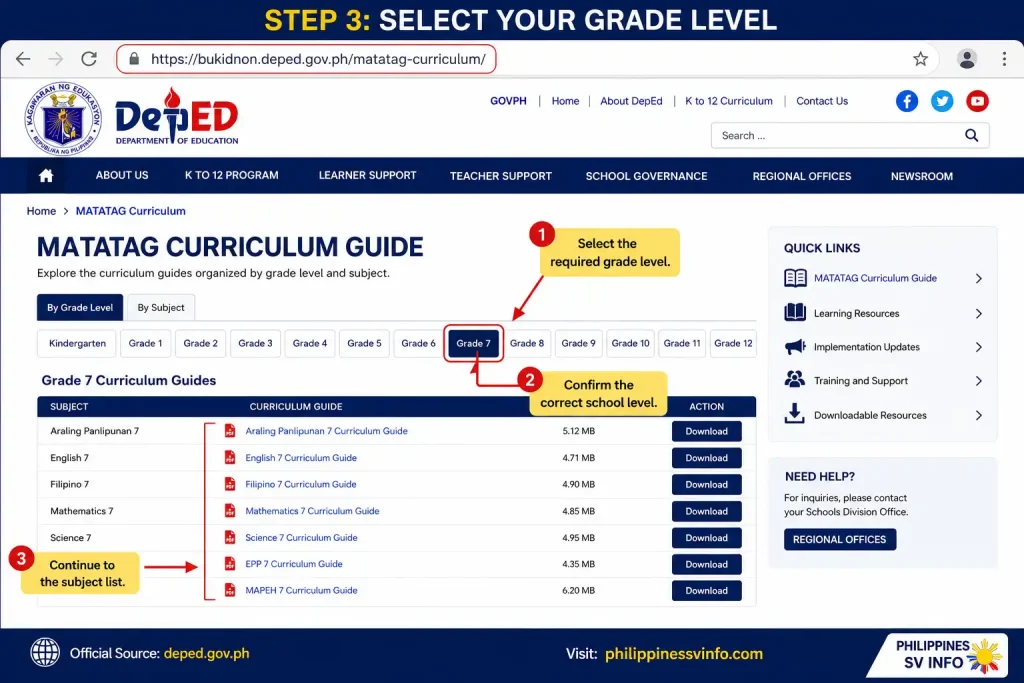
Step 4: Choose the Subject Curriculum Guide
Select the subject you need, such as Mathematics, Science, English, Filipino, or any other available learning area under the matatag curriculum guide.

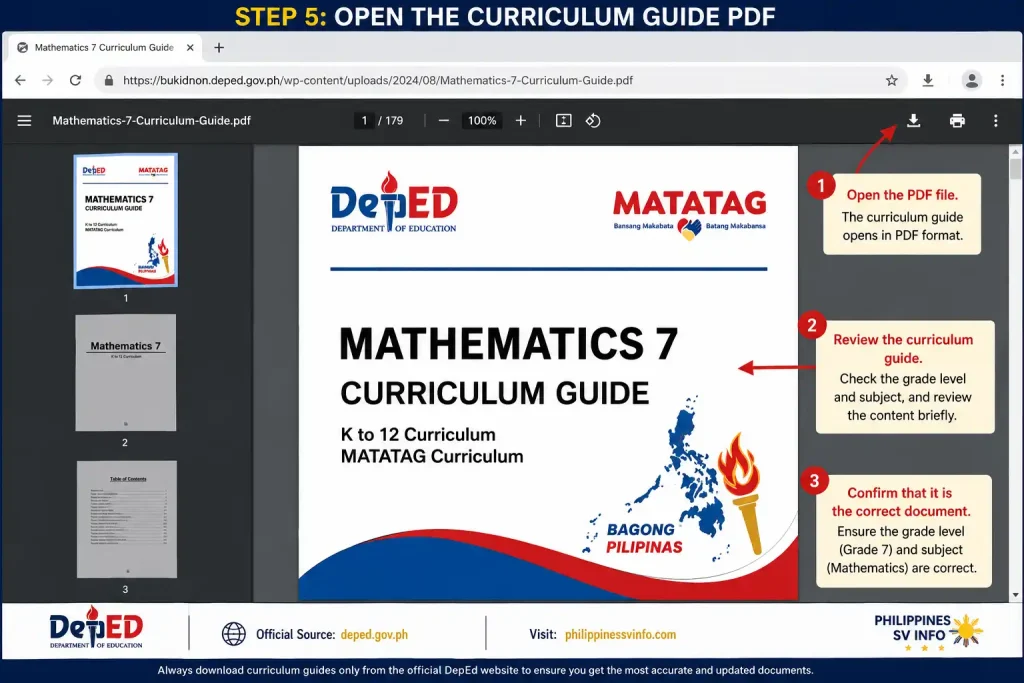
Step 5: Open the Curriculum Guide PDF
The selected curriculum guide will open in PDF format. Review the document briefly to ensure it matches the correct grade level and subject before downloading.
Step 6: Download the MATATAG Curriculum Guide
Use the download option available in your browser or PDF viewer to save the curriculum guide to your device for offline access.
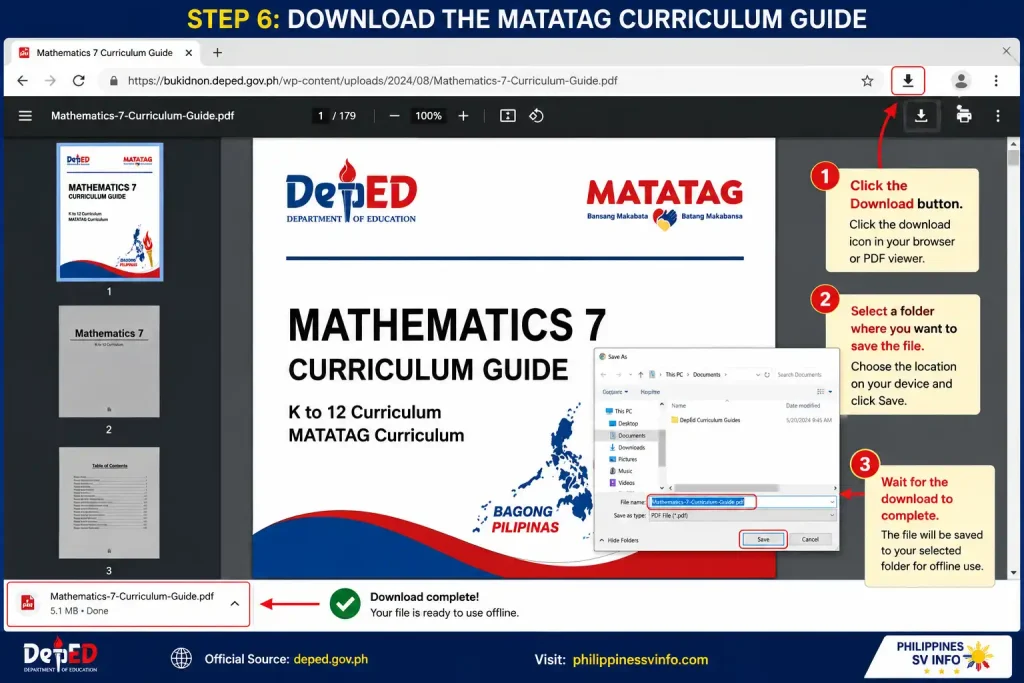
Step 7: Save the PDF to Your Device
Store the downloaded curriculum guide in a dedicated folder so it can be accessed easily whenever needed. You may also back it up using cloud storage.

Step 8: Print the Curriculum Guide (Optional)
If you need a printed copy for classroom use or lesson planning, you can print the downloaded curriculum guide using your preferred printer settings.
MATATAG Curriculum Meaning, Logo, and What It Stands For
The MATATAG Curriculum takes its name from the Filipino word “matatag,” which means strong, resilient, and steadfast. If you are searching for the MATATAG curriculum meaning, it refers to the Department of Education’s vision of building a stronger, more focused, and learner-centred basic education system. This reflects the Department of Education’s commitment to helping Filipino learners develop solid academic foundations, practical life skills, and positive values. Rather than focusing only on academic achievement, the curriculum prepares students for lifelong learning, responsible citizenship, and future success.
Beyond its meaning, MATATAG is also an acronym that represents the four guiding pillars of the curriculum. These principles shape curriculum development, classroom instruction, and learner growth across Philippine schools. The official DepEd MATATAG logo, together with the slogan “Bansang Makabata, Batang Makabansa” (“A Nation for Children, Children for the Nation”), reinforces this vision by highlighting the shared responsibility of the nation and its children in building a better future through quality education.
What Does MATATAG Stand For?
Each letter in MATATAG represents one of the curriculum’s four core pillars:
| Acronym | Meaning | Purpose |
|---|---|---|
| Ma | Makabansa (Patriotic) | Develops national identity, love for the Philippines, and responsible citizenship. |
| Ta | Matao (People-Centred) | Places learners’ needs, well-being, and holistic development at the heart of education. |
| Ta | Mahas (Competent) | Strengthens foundational learning while developing higher-order thinking and practical skills. |
| G | Matatag (Resilient) | Builds resilience, strong character, adaptability, and a sustainable education system. |
The Four Pillars of the MATATAG Curriculum
Every learning competency, teaching strategy, and curriculum guide under this is built around four interconnected pillars. Together, they provide the foundation for improving educational quality while ensuring that learners receive relevant, inclusive, and future-ready education.
Makabansa (Patriotic)
The Makabansa pillar focuses on nurturing responsible citizens who value their country, respect its history, and actively contribute to national development.
Key priorities include:
Matao (People-Centred)
The Matao pillar ensures that every learner remains at the centre of the educational process. It recognises that students have different backgrounds, learning styles, and educational needs.
Its objectives include:
Mahas (Competent)
The Mahas pillar is designed to equip learners with the academic knowledge and practical competencies required for higher education, employment, and everyday life.
This pillar places strong emphasis on:
Digital Learning Requirements
As technology becomes increasingly integrated into education, digital literacy forms an important part of the Mahas pillar. Learners participating in technology-assisted or blended learning may benefit from having access to:
While many schools continue to use printed learning materials, access to digital devices can enhance learning experiences where technology-based instruction is available.
How Can MATATAG Help Students?
The matatag curriculum guide is designed to make learning more meaningful, engaging, and manageable for Filipino students. By reducing curriculum overload and focusing on essential competencies, learners have more time to understand concepts rather than simply memorising lessons. Early implementation during School Year 2024–2025 has shown that the curriculum encourages active participation, strengthens foundational skills, and supports the overall development of every learner.
Instead of concentrating solely on academic achievement, this promotes a balanced approach that develops students intellectually, emotionally, socially, and physically. Through learner-centred teaching methods and practical classroom activities, students are better prepared for higher education, future careers, and everyday life.
1. Builds Strong Foundational Skills
One of the primary goals of the MATATAG Curriculum is to strengthen literacy and numeracy during the early years of education. Greater classroom time is devoted to language, mathematics, and science so that students develop the essential skills needed before progressing to more advanced subjects.
Key benefits include:
2. Develops Critical Thinking and Problem-Solving Skills
The curriculum encourages students to think independently rather than rely on memorisation. Teachers use discussions, real-life examples, collaborative activities, and problem-based learning to help learners analyse situations and make informed decisions.
Students gradually develop the ability to:
These skills are essential for success in higher education and today’s rapidly changing workplace.
3. Encourages Holistic Development
This recognises that education extends beyond academics. Alongside core subjects, it promotes character development, physical wellness, creativity, and emotional well-being to help learners grow into well-rounded individuals.
Areas of development include:
4. Increases Student Motivation
Because the curriculum places learners at the centre of the teaching process, students receive instruction that better matches their abilities and learning pace. Interactive lessons, meaningful activities, and supportive classroom environments help increase confidence and encourage active participation.
As students experience greater success in learning, they become more motivated to attend school, participate in class, and continue improving their skills.
5. Improves Learning Outcomes
With fewer competencies to cover each school year, teachers can devote more time to reinforcing important concepts and providing additional support where needed. This results in deeper understanding, stronger academic performance, and improved overall learning outcomes.
The curriculum aims to help every learner achieve mastery instead of simply completing lessons.
6. Prepares Students for Lifelong Success
Beyond classroom learning, this portal equips students with practical skills that remain valuable throughout their lives. Communication, collaboration, digital literacy, creativity, and critical thinking prepare learners for higher education, employment, entrepreneurship, and active participation in society.
By developing these lifelong competencies, students become better prepared to adapt to changing technologies, workplace demands, and future opportunities.
MATATAG Curriculum Subjects and Key Changes
This portal introduces a more streamlined learning structure across different grade levels. Rather than overwhelming learners with numerous subjects, the curriculum focuses on essential competencies appropriate for each stage of development. As students progress through school, additional learning areas are introduced gradually, allowing them to build knowledge and skills step by step.
Kindergarten (Implemented SY 2024–2025)
The Kindergarten programme continues its play-based approach while aligning with the goals of this system. Learning activities are designed to prepare young children for formal schooling by strengthening early literacy, numeracy, communication, and social development through structured play.
Major learning areas include:
The emphasis remains on creating enjoyable learning experiences that encourage curiosity and confidence.
Grade 1 (Implemented SY 2024–2025)
Grade 1 introduces one of the biggest structural changes under the MATATAG Curriculum. The number of learning areas has been reduced from seven to five, allowing teachers to spend more time helping learners master fundamental concepts.
Core Subjects
This simplified structure reduces learning pressure while establishing a strong academic foundation.
Grade 4 (Implemented SY 2024–2025)
Grade 4 serves as a transition from the simplified early-grade curriculum to more specialised learning areas. Subjects become more detailed while remaining manageable for intermediate learners.
Key curriculum updates include:
This stage helps learners expand their academic knowledge while building on the skills developed during the primary grades.
Grade 7 (Implemented SY 2024–2025)
Junior High School introduces a broader and more specialised curriculum that prepares students for future academic and career pathways.
Major changes include:
Students are encouraged to apply knowledge through projects, practical activities, and real-life learning experiences.
Grade 3 & Grade 6 (Implementing SY 2026–2027)
The third phase of the MATATAG rollout covers Grade 3 and Grade 6.
Grade 3
Learning continues to strengthen literacy and language development by introducing:
Grade 6
Before entering Junior High School, learners receive a more focused curriculum that allows deeper understanding of key academic areas.
Important improvements include:
Grade 5 & Grade 8 (Implementing SY 2025–2026)
Grade 5
The curriculum places stronger emphasis on Philippine history, citizenship, and civic responsibility through Araling Panlipunan, supporting the goals of the Makabansa pillar.
Grade 8
Values formation becomes increasingly important as students enter adolescence. The curriculum strengthens ethical decision-making, peace education, responsible citizenship, and personal development while integrating these concepts across core learning areas.
Implementation Schedule (2024–2028)
The DepEd MATATAG Curriculum is being introduced through a phased implementation plan to ensure a smooth transition for schools, teachers, and learners across the Philippines. Rather than applying the MATATAG Curriculum to every grade level at once, the Department of Education (DepEd) is rolling it out gradually over four school years. This approach allows educators to receive training, schools to prepare learning resources, and the MATATAG Curriculum Guide to be implemented more effectively.
Each implementation phase covers selected grade levels before expanding to the next group in the following school year. By following this structured timeline, DepEd launches MATATAG Curriculum through a gradual nationwide rollout, allowing DepEd to monitor progress, address implementation challenges, and continuously improve classroom delivery across the Philippines.
| School Year | Grade Levels Covered | Implementation Phase |
|---|---|---|
| 2024–2025 | Kindergarten, Grade 1, Grade 4, Grade 7 | First Phase |
| 2025–2026 | Grade 2, Grade 5, Grade 8 | Second Phase |
| 2026–2027 | Grade 3, Grade 6, Grade 9 | Third Phase |
| 2027–2028 | Grade 10 | Full Implementation |
Once all grade levels have adopted the new curriculum, the first complete MATATAG K–10 cohort—students who began Kindergarten in School Year 2024–2025—is expected to complete Grade 10 in 2034.
Salient Features of MATATAG Curriculum
This portal introduces several improvements designed to strengthen basic education while making classroom instruction more focused, engaging, and learner-centred. These features support the curriculum’s goal of improving learning outcomes and preparing students with the knowledge, skills, and values needed for lifelong success.
1. Strong Focus on Foundational Learning
One of the biggest changes under the MATATAG Curriculum is its stronger emphasis on essential learning areas. Instead of covering too many topics, the curriculum prioritises mastery of core subjects that form the foundation of future learning.
Key focus areas include:
Alongside these academic subjects, the curriculum promotes creativity, logical reasoning, collaboration, and critical thinking through classroom activities that encourage active participation rather than rote memorisation.
Students also continue to study MAPEH (Music, Arts, Physical Education, and Health), helping them develop creativity, physical wellness, and appreciation for Philippine culture and heritage.
2. Learner-Centred and Personalised Education
This recognises that every learner has unique strengths, abilities, and learning styles. Instead of expecting all students to learn at the same pace, teachers are encouraged to use flexible instructional approaches that address individual learning needs.
This learner-centred approach aims to:
By making instruction more responsive, the curriculum helps ensure that every learner has a better opportunity to succeed.
3. More Meaningful Assessment Methods
Assessment under the MATATAG Curriculum goes beyond traditional written examinations. While formal tests remain important, teachers also use continuous assessment methods to monitor student progress throughout the school year.
These assessment strategies may include:
This balanced approach allows teachers to identify learning gaps early, provide timely feedback, and support continuous improvement rather than relying solely on final examination results.
4. Modern and Interactive Teaching Approaches
This encourages teachers to move away from purely lecture-based instruction and adopt more engaging teaching strategies. Through the Instructional Design Framework (IDF), classroom learning becomes more interactive, collaborative, and student-centred.
Teachers serve as learning facilitators by encouraging students to:
These teaching methods help create more meaningful learning experiences while improving student engagement and understanding.
Teachers Call for More Training as Takes Effect
As the MATATAG Curriculum Guide continues to roll out across the Philippines, teachers are adapting to revised learning competencies, updated classroom practices, and new instructional approaches under the DepEd MATATAG Curriculum. While the curriculum is designed to strengthen learning outcomes and reduce curriculum congestion, many educators believe that its successful implementation depends on continuous professional development and practical classroom support.
Many schools and education stakeholders have called for additional teacher training, updated instructional resources, and ongoing technical assistance to help educators confidently implement the MATATAG Curriculum. Through workshops, mentoring programmes, and classroom-based coaching, MATATAG Curriculum DepEd initiatives can better equip teachers to deliver quality instruction and ensure that learners fully benefit from the goals of the new curriculum.
Benefits of the MATATAG Curriculum
This system is expected to bring lasting improvements to Philippine basic education by strengthening foundational learning, enhancing teaching practices, and preparing learners for future academic and career success. By reducing curriculum congestion and focusing on essential competencies, the curriculum creates a more effective learning environment for both students and teachers.
Benefits for Students
The matatag curriculum guide is designed to help students develop the knowledge, skills, and values needed to succeed in school and beyond. With greater emphasis on literacy, numeracy, critical thinking, and character development, learners are given more opportunities to understand concepts deeply instead of simply completing lessons.
Some of the key benefits include:
The curriculum also prepares learners for lifelong learning by equipping them with practical competencies that remain valuable in higher education, employment, and everyday life.
Benefits for Teachers
Teachers also benefit from the streamlined structure of this portal. With fewer learning competencies to cover, educators can spend more time explaining lessons, providing meaningful classroom activities, and supporting learners who need additional guidance.
Advantages for teachers include:
This approach enables teachers to build stronger relationships with learners while delivering higher-quality instruction.
Challenges and Concerns in Implementation
Although this portal represents a significant step forward for Philippine education, its long-term success depends on effective implementation. Several practical challenges must be addressed to ensure that schools, teachers, and learners fully benefit from the curriculum reforms.
1. Teacher Readiness and Professional Development
One of the biggest challenges is preparing educators to implement the new curriculum effectively. The shift from traditional teaching methods to learner-centred instruction requires teachers to develop new classroom strategies, instructional skills, and assessment techniques.
Important considerations include:
Providing consistent professional support will help teachers confidently apply the goals of this portal in their classrooms.
2. Availability of Quality Learning Resources
Successful implementation depends heavily on the timely distribution of learning materials. Schools need curriculum guides, teacher manuals, textbooks, and learner resources that fully align with the revised competencies introduced under this.
Key challenges include:
Ensuring that schools receive complete and updated resources is essential for consistent implementation nationwide.
3. Supporting Mastery of Learning
The curriculum places strong emphasis on mastery of foundational skills before students progress to more advanced topics. Maintaining this goal requires continuous learner support and effective intervention programmes for students experiencing learning difficulties.
Schools can strengthen learner achievement by:
This approach helps minimise learning gaps and promotes stronger academic performance throughout the basic education journey.
4. School Facilities and Classroom Conditions
The success of learner-centred teaching also depends on the learning environment. Some schools continue to face challenges related to classroom capacity and educational facilities, which may affect curriculum implementation.
Common concerns include:
Improving school infrastructure will further support the objectives of this portal and enhance students’ overall learning experience.
5. Monitoring, Evaluation, and Continuous Improvement
Because the matatag curriculum guide is being implemented gradually, continuous monitoring plays an important role in identifying strengths and areas for improvement. Regular evaluation allows the Department of Education to refine curriculum guides, strengthen teacher training, and improve resource allocation.
Effective monitoring should include:
Ongoing assessment ensures that the curriculum continues to evolve and effectively meets the educational needs of Filipino learners.
Frequently Asked Questions (FAQs)
Conclusion
The MATATAG Curriculum Guide Philippines 2026 is an important resource that supports the nationwide implementation of the MATATAG Curriculum across Philippine schools. By simplifying learning competencies, strengthening foundational literacy and numeracy, and promoting learner-centred teaching, the DepEd MATATAG Curriculum aims to provide every Filipino learner with a stronger academic foundation and the practical skills needed for lifelong success. Its phased implementation also allows schools and teachers to gradually adapt to the new framework while ensuring a smooth transition across all grade levels.
Whether you are a teacher preparing lesson plans, a school administrator implementing curriculum changes, a parent supporting your child’s education, or a learner looking for reliable information, the MATATAG Curriculum Guide serves as a valuable reference for understanding the latest learning standards, subjects, and competencies. As the MATATAG Curriculum continues to expand nationwide, staying updated with official DepEd curriculum guides and implementation announcements will help ensure effective teaching, meaningful learning, and better educational outcomes for all Filipino learners.